
(Content warning: Solitary confinement)
Dear Mom,
A lot of unbelievable change was born out of 2024, swirling around my redefined “participation” in the criminal justice system. There is no doubt about that. But there’s one change in particular I’m sure would surprise you the most.
I became known for singing in the Dane County Jail.
Let’s back this up to the 1990’s, when I “learned to sing” in church. It’s simple: we didn’t. I learned the art of mouthing the words to songs from you. We were not a “sing-along” type family. Not in church, to the car radio, not even in school concerts. If it was socially unacceptable to skip singing, we’d lip synch. Even the annual singing of “Happy Birthday” was prefaced with a quick glance around the room, checking that we were “really going to do this again”.
I didn’t object whatsoever; a big part of my gender dysphoria was related to the sound of my voice. It included how I sounded speaking and even laughing. Singing was most certainly out of the question. For the first 28 years of my life, my singing was confined to the car, alone, with the music loud enough I couldn’t even hear myself.
That changed in seg, in mid-August of 2024, in Dane County Jail. Mom, you’re obviously unfamiliar with the layout of DCJ, so I’ll explain what “seg” means.
The DCJ, like most jails, houses 99% of inmates in general population or “administrative confinement”. General population allows for property from commissary, human interaction, books to read, a TV, and access to daily hygiene in the form of soap and a shower. Administrative confinement is a non-punitive version of that with the same access, however physical proximity and movement is more controlled for instances of institutional and personal security.
Conversely, a “seg cell” is effectively an underground tomb. It is an extremely small, all cement closet for a human being, smaller than a regular parking space. The door is thick steel. A meal tray slot is unbolted and opened briefly three times a day. There is a deafening silence, only occasionally permeated a few times a day by the screams of pain or terror of a new occupant being brought in. There is no property for purchase, no human contact, often no clothing. Bright lights are left on 24 hours of the day.
The configuration of a seg cell is designed for short-term use. Other jails often use the term “intake cell”. Dane County Jail has numerous policies outlining “seg” usage within DCSO 600.00. One of those policies explicitly states inmates should not be housed in “seg” for longer than 24 hours due to gender identity or transgender status.
With my 46 days in seg during July and August 2024 came soul-crushing total sensory deprivation. There was no sound – no TV, no music, no human voices, not even the sound of weather, such as raindrops or thunder. It was not merely partially or periodically quiet – it was a permanent, heavy silence with no hope for change. It was a silence that layers everything around you like a blanket of snow.
I missed sound so profoundly after a while that I decided I was going to start singing. Mom – you understand how improbable that is. That should give you a sense of my level of desperation. We don’t sing.
Except I did. It started with “Hallelujah”. The song was originally written by Leonard Cohen, but the version that plays in my head is Rufus Wainwright’s cover, his raspy, haunting voice capturing heartbreak, resignation, and every feeling in between.
There was no real thought process to picking it. Much as some of the thoughts, beliefs, and emotions that find their way into your head after prolonged seg don’t connect to anything, the song didn’t either (this phenomenon is sometimes referred to as “SHU Syndrome”). It was just there, with a sudden, compulsive need to sing it over and over, despite my lifelong aversion to breaking out in song.
After a few days of the three and a half verses I could remember, I requested Wellpath Mental Health LLC print a copy of the lyrics. To this day, this single act was the only tangible mental health treatment I received in Dane County Jail with any meaningful outcome. With a single page of specially-approved paper, I had music back.
With the full lyrics and the auditory impossibility of an audience, I gained confidence. I began realizing the idea of singing from my core, releasing full notes instead of embarrassed whispers. I found song from deep in my chest – bellowing out in a deep, low, masculine chorus. Then it hit me – the voice I was finally hearing was the voice I heard in my head when I’d sung to the blaring radio pre-transition. The difference was the sound coming out was now me. Hallelujah.
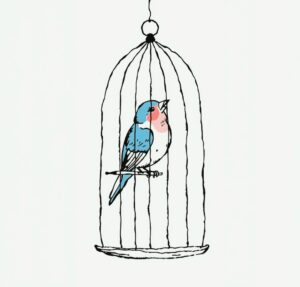
When I made it to general population, the shyness was back. Singing to an audience of zero was one thing. Coming in new to “real” jail as a transgender former cop was already daunting enough. I wasn’t about to add “also singing for the first time” right out of the literal gate.
Mom – here’s the thing about living with the women of DCJ. After a decade of near isolation in addiction, the forced reintegration back into human interaction brought my voice back. It had been over a decade since I had any consistent social interaction that wasn’t rooted in active alcoholism or trauma-bonding among first responders. Being put in general population got me talking to humans, daily, about our utterly boring lives inside, in stark contrast to our consistently crazy lives outside. It was a community of peers.
I grew into my own voice, and after a few short months of general population, I was singing again. Mom – I was singing to a JAIL. Me, the transgender former cop who would’ve sooner run into gunfire than get caught singing.
It started with “A Whole New World” from “Aladdin”, a humorous and ironic nod to my new life in a cement, Brutalist building built in 1955. My repertoire quickly expanded: “Thunder Rolls”, “Total Eclipse of the Heart”, “The Devil Went Down To Georgia”, “County Roads”, and more.
As time went on, the selections became less about ability to sing, and more about what we could sing together. Without Google, Transform Dane kept the lyrics coming through the mail. Once again, it was in connection that I found my salvation. For most of March 2025, we tested the sanity of jail staff by enthusiastically belting “I’m Coming Out” by Diana Ross inside cell block 611. I nearly was “locked down” for greeting inmates by singing the opening bars of “Lion King” down the echoing halls.
Mom – by my last few months in DCJ, I was no longer just singing. I was giving full-blown performances. I gained negative street-cred rapping to early 2000’s Eminem. I was nicknamed “Sheldon” from “The Big Bang Theory” in the process of my “rap game” development. (I was told my attempts at dancing more closely resembled bowling.) Taylor Swift, bless her, received the most poignant yet ridiculous numbers. Deputies perhaps lost track of gender norms to expect, as I belted out, “You be the prince and I’ll be the princess, it’s a love story baby just say YES.” Forget gender – ANY norms.
Mom, I do not claim to be good at singing now, but I’ve also realized that’s not the point. I enjoy it, and I’ve learned through the twists and turns my life has taken to appreciate the magnitude of finding unexpected joy in anything, no matter how small or ridiculous.
I owe much of that gratitude to these human beings we call criminals. They were there, live, a literal captive audience for my “Transgender Former Cop” jail open mic. They looked past the labels, stereotypes, and stigmas in a way that only those who have pleaded for the same from the world can.
They brought back my voice, raised in song for no other reason but the joy of it – in the most unlikely place.
Still me,






Leave A Comment